Thursday, 23 October 2014

Pentecost 19
19th October 2014
Give to God what belongs to God...

Revd Andrew Bain
Readings:
Isaiah 45: 1-7 – I am the God of Israel, who summons you by name
Matthew 22: 15-22 – Give to Caesar what belongs to Caesar

“When the chief priests and Pharisees had heard the parables, they realised that Jesus was speaking about them”.
Just imagine you’ve been described as wicked vineyard tenants who kill the owner’s son; ungrateful wedding guests who don’t show up to the most gracious invitation ever. Who would want to be the baddy in the stories this young preacher is just enthralling the people with? The scribes and Pharisees aren’t used to being typecast as anything other than admirable. So they respond by acting out the very behaviour for which they’ve just been condemned. They set a trap for the owner’s son. The final trap will need thirty pieces of silver and a disillusioned Judas. For now this is only a verbal trap, but the clever Pharisees, they think it’s a killer. “Get out of this one”, is what they’re thinking.
The search for the killer question is something we’ve got very used to in our media age. We’ve watched politicians squirm under the relentless fire of Jeremy Paxman, almost skewering some hapless minister with a question he can’t or won’t answer. In our recent pre-referendum debates we saw the same tactic at work with each side looking for that knock-down question that just shows your opponent unable or unwilling to tell the truth the questioner wants to hear – although, in fact, this kind of question has little or no interest in truth. It’s just a weapon.
 Matthew couldn’t make Jesus’ questioners any slimier if he tried: “Teacher, we know that you are sincere and teach the truth of God”. This unctuous approach, nakedly trying to catch Jesus off-guard, doesn’t just paint them as that snake in the grass tempter who shows up regularly for Jesus (as in the wilderness – even the Devil can quote scripture); it also shows that behind their weasel words there’s something else. There’s the fear, just a grain of it, that maybe this Jesus just might be the owner’s son, the expected One. It’s only a suspicion, but it’s one they’re determined to stamp on, because if he is, then the game’s up. They’ve a lot to lose.
So in their minds this is a lose/lose situation for Jesus. If he says: Withhold your taxes; don’t pay money to this heathen occupying power, then the wrath of Rome will soon be down on his head (and they’ll make sure of that) and he’ll alienate all the poor quiet folks who only want a quiet life because life’s hard enough already – they know what revolutions cost people like themselves, and it’s always in blood. But if he says: Pay the taxes, be good, dutiful citizens of the Empire, then the zealots, who want him to use his popularity to raise an army and throw the Romans out – never mind all this “Consider the lilies” stuff – they’re going to give up on him and look elsewhere for their Messiah.
It’s a killer question. It’s a great question. They must have been rubbing their hands with glee. But Jesus subverts it totally. Because their question focused totally on this Caesar, the fearsome emperor who has the power of life or death over everyone. But suddenly Jesus brings up God. They didn’t see that coming. This is the God of Isaiah for whom even kings and emperors, even Cyrus of Persia (the Caesar of his day) are in his hands. And in a heartbeat this ground of a killer question in which they had so much confidence just slips from beneath their feet.
These questioners are supposed to be experts in the faith, but Jesus, this preacher from some backwater village in Galilee, has outdone and undone them all. “This is Caesar’s face, isn’t it – so give him what’s his. But what about what you give to God?”
So, having arrived incensed because they and those who sent them know where they fit into these stories of Jesus, and they don’t like it one bit, now they’re trapped again in a role which hasn’t been written for them by Jesus, but which they’ve chosen for themselves. The ungrateful tenants, the guests who spurn their Lord’s invitation, they’re now shown up again as threadbare, unworthy heirs of the Covenant. They’ve missed the mark again, got themselves exactly where they wouldn’t want to be and shouldn’t be.
And that’s a thought that should maybe make us not too judgemental about these messengers of the Pharisees. Because missing the mark, finding that you’re acting the wrong part in the story, speaking the wrong lines, putting your hopes in the wrong things, making the bad choice – well, I never do that, or do I?
But of course I do. I reject the invitation to the wedding banquet whenever I refuse God’s invitation to give him the gift of my trust and obedience. When I choose to take someone down rather than build them up, speak unkindly about someone; when I withhold forgiveness in spite of the fact that God’s forgiven me countless times; whenever maybe I choose to sit in darkness even when I can hear him calling me. You know, I’ll give to Caesar because I have to. As the tax adverts say threateningly nowadays: “We know where you live”. I’ll do what the world expects or what makes me look good.

But the Lord of the universe to whom I owe everything never coerces me in any way at all – ever. He just sends invitations, beautiful gilt-edged invitations, to join the banquet of life with Jesus joyfully, generously, holding nothing back. I don’t have to act out these miserable lines that Matthew writes, which could be for any of us, to be always the one who refuses, the one who sends apologies and won’t join in. We can re-write the script. And next time an invitation comes – an invitation that in some way says “Choose life” – we can, this time, say “Yes”, or as Jesus puts it: Give to God what belongs to God. And we know that means everything. Amen.

Friday, 3 October 2014

PENTECOST 16
Sunday 28th September 2014
Two Sons
Peter Davey


Readings:
Philippians 2: 1-13
Matthew 21: 23-32

Let the same mind be in you that was in Christ Jesus.

Our Gospel reading this morning from Matthew contains one of those little stories of Jesus that are so deceptively simple. A father has two sons and he says to the first son, “Go and work in the vineyard son”. And the son says “No, dad, I have better things to do!”, but then he goes away and does work in the vineyard. The father says to the second son, “Go and work in the vineyard son”. And the son says, “Yes, dad, of course”, but then goes away and doesn’t work in the vineyard. Which one of the 2 did the father’s will? They say, “The first”. And then Jesus puts in the punchline, “Believe me, prostitutes and dishonest tax-collectors will enter the Kingdom of Heaven before you!”

Now Jesus was directing this story to the Jewish elders and authorities in the Temple in Jerusalem, but let us not kid ourselves. In 21st Century Dunbar, this story of Jesus is directed towards us and all Church goers. So what do we understand by this story?

Well it seems to me that the first son represents those people in our community  who, for various reasons, are on the edge of society. In Dunbar we might think of drug dealers, vandals, prostitutes or thieves. Such people know that they are not honest and upright citizens and they don’t even pretend to be. The second son however represents those people who see themselves as good citizens who try and live lives according to the values they were taught as children and particularly those who are trying to be good Christians. These people try their best to live honest lies adhering to the moral code they were taught by their parents or by the church or what they read in the Bible. To be honest, I think most of us fit into the second son category. These two sons are very much like the two sons in another famous parable of Jesus; that of the Prodigal Son. The first son is the one that takes his share of his father’s inheritance and goes away and spends it all on drink, drugs and women. And then, when it all goes horribly wrong, he realises what a complete fool he has been and returns to his father to beg his forgiveness. The second son in that story is the one who stayed at home and did his duty, but when his prodigal brother returned he resented his father’s generosity and love for his brother saying, I have been here doing my duty all these years and you never threw a party for me!”    In this story Jesus is saying that you are better off being a prodigal and then recognising yourself as hopeless, rather than trying to live a good life and being self-righteous. The point Jesus is trying to make is that entering the Kingdom of Heaven is about dying to self and becoming like a child, relying totally on the love and forgiveness of the Father. The reason prostitutes and tax-collectors enter the kingdom first is that they are more likely to acknowledge their unworthiness while the so called good people think they can rely on their good deeds to get them into the Kingdom.

But in our gospel story Jesus says that the 2nd son says he will work in the vineyard but then doesn’t do so. This is because what Jesus means by working in the vineyard is bearing the fruit of love and compassion in our lives like that of his own life but such a life is impossible without the Spirit. That is why the very righteous Pharasee and Temple leader nicodemus was told by Jesus that “he must be born again of the Spirit”. For only the Spirit of Christ in us will allow us to bear the fruit of love and compassion. Our own self is incapable of doing it and we have to get it out of the way, to die,  and let the Spirit of Christ abide in us. But first of all we must recognise our utter hopelessness  to truly love our neighbour and then we can allow Christ to live in us.

Now you might be sitting there and thinking, “Ah yes, but it is all very well for you to stand there and say these things, but aren’t you also one of those in the category of the second son?”, and you would be right! I was brought up as a Christian and live a reasonably upright and moral life. I go to church on Sundays and do good deeds from time to time. It is for each one of us to meditate on this parable of Jesus and decide if we are indeed one of the self-righteous ones that Jesus is so critical of. This is where Paul’s words in the epistle are so helpful. He writes, Do nothing from selfish ambition or conceit but in humility regard others as better than yourselves. Let each of you look not to your own interests but to the interests of others. Let the same mind be in you that was in Christ Jesus”. Each one of us has to reflect on whether we do have the mind of Jesus, and every day surrender ourselves to the Spirit of Christ and allow him to live in us and love through us. No amount of reading or studying will transform our minds into the mind of Christ. Only the Spirit can do that. As Cardinal Newman puts it in the prayer I love so much, “Jesus, flood my soul with your Spirit and Life. Penetrate and possess my whole being so utterly that all my life may only be a radiance of yours.” This transformation is a long process and we have to work it out for ourselves. 

In the epistle Paul puts it this way, “Work out your own salvation in fear and trembling. For it is God who is at work in you enabling you both to will and to work for his good pleasure”.


So let us, through contemplation and in the privacy of our own hearts, allow the Spirit to transform our minds into the mind of Christ so that our thoughts, words and actions may be those of Christ Jesus born from love and compassion. The good news is that Jesus tells us in his parables that once we recognise that all our efforts to be good and righteous are useless and we too come to the father for forgiveness, the Father is waiting to welcome us into the Kingdom.  

Monday, 22 September 2014

HARVEST SUNDAY
The Fruits of the Spirit
A sermon for Harvest
and our first Sunday after the Referendum
Revd Andrew Bain

There are all kinds of harvests, and harvest is an image Jesus uses when he wants to concentrate people’s minds on some critical moment, a “now” moment, a moment of choice and decision. The harvest is ready – God’s people are waiting for good news – but the labourers are few. Wheat and tares, let them both grow together until that day when only the Lord of the Harvest can separate bad from good. The parables of Jesus are full of references to seeds and harvests, the very essence of life for people whose lives depended on them.
But what Jesus is saying is: ask yourself, what’s the harvest of your life going to be? Will we be the seed that falls in good soil and produces a hundredfold, or the seed that gets choked by the weeds and the cares of this world? Will we be the seed that dies to itself and so bears much fruit, or the mustard seed that, tiny as it is, grows into a great tree and the birds of the air make their nests in its branches?
There’s even a kind of warning parable with a rather bad-tempered vineyard owner who has a fig tree that yields no figs. Judgement is close. Root it up, he says. Why should it use up the ground? But the vine-dresser, who is Jesus, implores the owner for time – another year in which to nurture the tree, to water its roots and care for it. Just wait, he says: this tree will bear fruit – you’ll see.
And I guess that’s God’s faith in us. On a day when we come to give thanks for the fruits of the earth, he says to us: And these are the fruits I see in you, and expect in you. He knows what we’re capable of which is why he never gives up on us. At the end of the parable of the sower:
And as for that in the good soil, they are those who, hearing the word, hold it fast in an honest and good heart, and bring forth fruit with patience.
In this momentous week, with all its possibilities for divisiveness and rancour, this possibility of fruitfulness for good that we really are capable of is something truly to be thankful for. We can be thankful that the fruits of our history and our way of life made a referendum possible at all. Because it’s the struggles of our ancestors that put such a possibility into our hands. In many ways the Christian contribution to society has been to demand of each generation a better harvest, a better life, and for more than just the few or the rich or the powerful: Think of William Wilberforce and emancipation of slaves; Elizabeth Fry and prison reform; the Christian friendly societies which became the trades unions; more recently the civil rights movement in the USA (Martin Luther King and his “I have a dream!”) and  the struggle against apartheid, and so on and on through the generations.
The Church is called to scatter seeds of hope and justice in order to create a kingdom that looks more like the Kingdom of Jesus Christ.
But before that great work can even begin, there is the harvest of your own heart to tend, and Paul knows exactly the fruits that’ll build up the Kingdom and bring us the fullness of life Jesus promises. The fruits of the spirit: love, joy, peace, patience, kindness, goodness, gentleness, faithfulness, self-control.
And to the Philippians he proposes a spiritual tending of the soul he guarantees leads to life: whatever is true, honourable, just, pure, pleasing, commendable, excellent, worthy of praise. He says: plant your minds with these things and you will have what you long for more than anything else: the harvest of peace. God’s Peace. We’re to fill our minds with these things, and our speaking too, I would say.
At the conclusion of a debate easily capable of rousing thoughts and feelings almost the polar opposites of the virtues I’ve just mentioned, the Christian presence is so needed to nurture and to heal. Taking the larger view, we’re reminded that here we have no abiding city but we seek that city which is above. Christians are resident aliens always. In the midst of the earthly kingdoms we find ourselves in, our calling is to bear fruit, lots of it, all the fruits Paul names. This is what transforms the kingdoms of this world. Christian people are always hopeful for what God still has in store for us (so a referendum really should be a beginning, not an ending), and Christian people are thankful – come, ye thankful people, come – thankful for a bounty of freedoms, and institutions and good people of all faiths or none who are clearly passionate about seeking the best for our country; a bounty of wonderful things about our life together, and far too easily taken for granted.

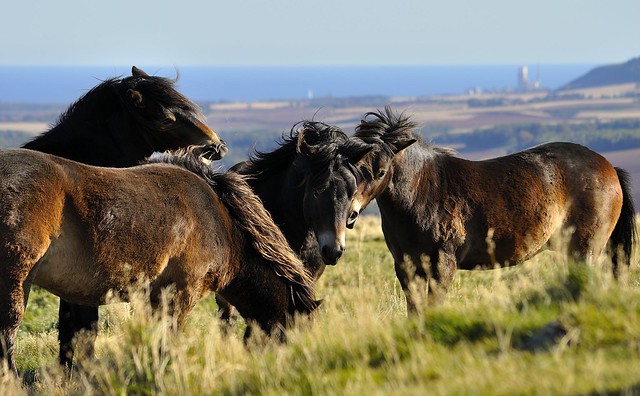
Yesterday afternoon I climbed to the top of Traprain Law to try and clear my head of all the jangle of stuff from this last week. From the summit there was a 360 degree view of a least three counties, from the place where our ancient forebears kept watch and said their prayers, and trusted in the seasons returning with their fruitfulness and their gift of life. I shared this view of blue sky and blue sea and stunningly beautiful countryside as far as the eye can see with about a dozen wild ponies who stood around me shaking their shaggy manes out of their eyes and no doubt wondering what I was doing there. No thoughts of politics and all the human storm and stress for them, nor for the swallows who darted and danced in the blue sky over my head. And the words of the psalmist came to me as a gift, as I took it all in: The earth is the Lord’s and the fullness thereof; the round world and they that dwell therein.

All things, and all of us, and all our hopes and dreams, and the fruits of our labours, and the fruits of the earth are held in God who gives not just all things, but his own very self. And as a sign and more than a sign of this he puts nothing less than himself into our hands today. The Bread of Life.  
So come, ye thankful people, come.

Saturday, 20 September 2014

HOLY CROSS SUNDAY
14th September 2014

GOD SO LOVED THE WORLD


Revd Andrew Bain
Readings:
Phil 2: 6-11 – Christ emptied himself, taking the form of a slave...
John 3: 13-17 – God so loved the world...

A number of years ago there was a great stushie about Mel Gibson’s film, “The Passion of the Christ”, which majored on the horror of the Cross, the crucifixion itself and the anguish and pain of it all. I have to confess I deliberately didn’t go to see it. Partly because I haven’t forgiven Mel Gibson for “Braveheart”(that isn’t a Referendum comment, by the way), but more seriously because his approach seemed both way too much and not remotely enough.

I say “too much” because showing us all that horror down to every gory detail misses the point, and because the meaning of the Cross in fact transcends all that – it belongs to everyone. If the Cross is only about the three hour anguish of the Man of Galilee, then frankly in the scales of human suffering – when you think of the anguish of families of hostages held by Islamic State under threat of beheading, and the sufferings of refugees now so many across the Middle East that they’ve stopped even telling us how many, and the Ebola virus claiming countless lives, well how much can we say about three hours on a Cross?

I once saw the Mum of a boy struggling with leukemia interviewed between the hymns on Songs of Praise and she just told it like it was and said, “Don’t talk to me about the Cross, I’ve been watching my son suffer for years.” So being overfocused on those three hours both insults people’s pain and it sells them desperately short.
For God so loved the world… And he loves the world so much that, like a true parent if you like, he can take our anger, our crying out at the sheer unfairness of things. Christopher Nolan, the Irish author who lived with cerebral palsy and died at the age of forty-three, describes a moment where the young disabled boy, Joseph, through whom he tells his own life story, has a moment of terrible despair and he rails against God in the crucified Christ.

A friend has taken him into Church. “What,” said Matthew, “Do you want to see the crucifix, Joseph?” He wheeled him over and there hanging up on the wall was a lifesize Christ crucified to a huge black cross. His pallid limp body sagged windswept and dead. Crowned with thorns, his grey face was streaked by caked blood, his wonderful eyes were turned vacantly upwards, his head fell backwards and his veins were taut in his throat. But Joseph was not seeing the sadness of the spectacle that day, his boy’s heart was broken and he knew who to blame. The bright angry eyes of the rebellious boy looked up at the great crucifix and swinging his left arm in a grand arc he made the two-finger sign at the dead Christ. He told God what he thought of him. He was furious still.

For Joseph this self-assertion before God is part of his spiritual journey, part of his growing up in faith, as it needs to be for all of us. Joseph loves the God he sometimes hates and that’s ok, and in the Eucharist he meets the crucified God in a special way, just as he is. One of Joseph’s problems is opening his mouth to receive the host when his uncontrolled reflexes keep his jaws jammed shut. “Once, when Joseph was in difficulty, the priest came up with a bold idea of his own – Hi Joseph, what were you doing in the Church yesterday? Were you riflin’ the poor box?

Joseph was so surprised by the accusation that his mouth fell open in astonishment. The priest immediately returned to prayer as he placed communion on the boy’s tongue. Such were Fr Flynn’s schemes, such his empathy that the boy became more and more relaxed over the years.

And so you see Joseph, no matter all the challenges he faces relaxing more and more into who he is and who he is with God. Nolan writes: “Communion served to join the silent boy with the silent God, and into his masked ear Joseph poured his mental whisperings, begging blessings to be showered on his faithful friends.”

Just this week I finished a book which is the most joyful stimulating response to the all atheism that’s been so popular recently. Francis Spufford writes with passion and nowhere more so than when he describes what’s happening on the Cross. “The doors of Jesus’ heart are wedged open wide, and in rushes the whole pestilential flood, the vile and roiling tide of human cruelties and failures and secrets. Let me take that from you, he is saying. Give that to me instead. Let me carry it. Let me be to blame instead. I am big enough. I am wide enough. I am not what you were told. I am not your king or your judge. I am the Father who longs for every last one of his children. I am the friend who will never leave you. I am the light behind the darkness. I am the shining your shame cannot extinguish. I am the ghost of love in the torture chamber. I am change and hope. I am the refining fire. I am the door where you thought there was only a wall. I am the earth that drinks up the bloodstain. I am gift without cost. I am. I am. I am. Before the foundations of the world, I am.”

I love this image of Jesus opening his heart universe wide to accept everything, for all of us for all time. All those things we know about ourselves but can scarcely even name to ourselves, our fears for a world of mind-numbing brutality, and even in this week our hopes and aspirations and anxieties for our own country’s future.


Francis Spufford makes the point. Our God isn’t born into some realm of timeless myth like the Gods of the Norse or the Romans or the Greeks. Our God took flesh in the reign of Caesar Augustus when Quirinius was governor of Syria, when everyone had to be registered to be taxed (not a referendum, but a census); and he died on a Cross when Pontius Pilate was Procurator of Judea. Our God comes in real time, in the time of nations and peoples, in the time of their hopes and their griefs. He comes in Joseph’s real time, the real time of a boy trapped in a body that won’t do what he wants. He comes in your real time and mine. He comes. And for you and for me, for Syria and Iraq, for Ukraine and Scotland, for all times and all places with one message ever the same: God so loves the world. 
 The Law of Love

Pentecost 13 7 September 2014
                                                                                                                           Liz Gordon
Readings:
Romans 13:8-14 – Love for the day is near
Matthew 18:15-20 - A brother who sins against you


‘The commandments... are summed up in this word, “Love your neighbour as yourself” Love does no harm to a neighbour; therefore, love is the fulfilling of the law.’

In his letter to the Christians in Rome Paul is teaching about keeping the law. But whose law?  Well this isn’t a lesson in ‘how to be a model Roman citizen’. Nor is it a lesson in ‘how to keep the Jewish law’ although, as a once zealous Pharisee, Paul would have been well equipped to give advice on that. No Paul‘s talking about God’s law as revealed to him by the risen Jesus. This is the law of God’s kingdom, the kingdom of Heaven which begins in the here and now.

Paul reiterates what Jesus taught, i.e. that keeping God’s law is not about abiding by a list of rules and regulations or  ‘thou shalt nots’.  No it’s actually all about love.

I can see the attraction of rules and regulations. After all they help create order and ensure life runs smoothly and, if we keep them we can tick off all the boxes, give ourselves a pat on the back and claim the moral high ground. The Pharisees had taken rule keeping to a whole new dimension with hundreds of minor regulations to be observed and they certainly took the moral high ground. Remember how they criticized Jesus for healing a man on the Sabbath? The thing is they had missed the point. And Jesus had harsh words for them, likening them to whitewashed tombs - beautiful on the outside but inside full of death and decay.

God’s concerned with what‘s in our hearts.  In the words of the psalmist ‘O  Lord... you do not take pleasure in burnt offerings, the sacrifices of God are a broken  spirit, a broken and a contrite heart O God you will not despise.’  These words were written by David, after he had broken the commandments big-time by sleeping with Bathsheba and then arranging for her husband to be murdered. He realised that what God required from him wasn’t a religious ritual but a fundamental change of heart.

So what does it mean to love your neighbour as yourself? Isn’t it a bit vague and woolly compared to the clear no nonsense laws laid down in the Ten Commandments?  Well whatever words we might use to describe Paul, vague and woolly certainly don’t spring to my mind.

You see, Paul had experienced a fundamental change of his heart and he had become as passionate about this new interpretation of the law as he’d previously been about the keeping of rules as a good Pharisee.

Indeed his passionate belief in this law of love inspires one of the most eloquent passages in the whole of Scripture - one that’s frequently used at weddings, funerals and other special services. In chapter 13 of his first letter to the church in Corinth, he describes the qualities of love and claims its supremacy over all other virtues. And reading his words we realise that love is certainly not a soft option.  Let’s just remind ourselves of those qualities of love.

‘Love is patient, love is kind. It does not envy, it does not boast. It is not rude, it is not self seeking, it is not easily angered. It keeps no record of wrong. Love does not delight in evil but rejoices in the truth. It always protects, always trusts, always hopes, always perseveres.’

Imagine a society in which people lived by that rule of love. War, poverty, cruelty and neglect couldn’t survive in such a climate. But such love is a tough ask -much more demanding than attending church on Sundays and refraining from murder, theft and adultery. So how can we begin to love like this?


The apostle John writes ‘we love because He first loved us’. God not only loves us, he IS love. His love is unconditional. He loves us as we are. Sometimes our life experience gives us a different view of love. If we’ve been neglected or abused we may grow up feeling we’re unlovable. Even if we’ve had loving parents we may still have grown up to believe that we are loved for being good or being successful.

Accepting the truth that God loves us as we are and really taking that truth into our hearts can be a liberating experience. If we can see ourselves as loveable then we can begin to see others as loveable too. The more we allow God to love us the easier it’ll be to share the gift of his love with our neighbours.

Of course we know that neighbour in this context extends way beyond the people who live in our street and is used by Jesus to refer to the whole of humanity and to those of different creeds and beliefs to our own. 

Amidst all the horror of recent news stories I came across two inspiring examples of love for one’s neighbour.

The first is the nurse, William Pooley, aged just 29 who went off to work with the dying in a hospice in Sierra Leone. While he was out there, he volunteered to work with victims of Ebola and ended up contracting the virus himself. His boss, the director of the hospice, in a television interview, summed him up in these words ‘He’s truly compassionate he really loves people’.

Another example which I read about in The Times is the unnamed (for obvious reasons) Sunni Muslim woman who has been risking her life to take food to Iraqui Christian families, who are in hiding in Quaraqosh. For her the law of love transcends any other that might be imposed on her.


Paul tells us that, without love, our best actions are worthless. God wants to use us as agents of his love in a troubled world and he wants us Christians to so love each other that, as Jesus says, the world will know that we are his disciples. Keeping the law of love isn’t easy. However, it’s not an option. It’s a requirement.

Tuesday, 19 August 2014

17 August 2014

Mary and the Dragon


Revd Andrew Bain
Readings:
Revelation 11:19–12:6 – a woman clothed with the sun
Luke 1: 46-55 – My soul magnifies the Lord

Well, there was a choice of readings for today’s festival; but there aren’t many readings that give you a real live dragon, so there really was no contest. Revelation it had to be.

We begin with a scene that could have come from “Indiana Jones and the Raiders of the Lost Ark”. The Ark of the Covenant surrounded by flashes of lightning, crashes of thunder, the very earth shaking and the Ark, the symbol of God’s promise, encompassed on every side by signs of terror.

But this scene gives way to an even more extraordinary vision. A woman clothed with the sun, the moon beneath her feet, and crowned with twelve stars representing the twelve tribes of Israel. And from her there comes the cry of all humanity. It’s the absolute vulnerability of bringing any child into the world. One of my sharpest memories of the night my eldest daughter was born was of leaving the Royal Infirmary in the middle of the night, something like four in the morning, and just overwhelmed by the emotion of it all; but also feeling a strange kind of indignation, because this was right in the middle of the Falklands War – and I remember thinking, “How dare anyone be fighting when my little girl’s just been born!”. Like all of that should somehow stop, just for her.
But the point of this fantastic amazing story is to say that from God’s perspective, I wasn’t wrong. At the cry of any mother, at any child’s first cry, the whole world should stop what it’s doing, and, yes, put away its weapons and fall down on its knees and worship.

So Mary stands in that place of vulnerability and hope and trust and joy for all of us. She’s pregnant with the divine life that’s always creating new things.

Now I like this picture of Mary, because her whole life is a great Yes to God. And a Yes to everything parenthood will mean. Not an easy Yes. Not a glib Yes. But Yes anyway, because she’ll be there at the foot of the Cross; there at the Resurrection; there on the day of Pentecost when the Spirit comes. Jesus couldn’t have shaken off this mother even if he’d wanted to.

So this is a real woman, a real mother, a real human being, and when your life is tough and things aren’t working out she’s there to remind us not just of her great love, but much more so the love she knows in God. (She always points away from herself: Whatever he says to you, do it).

This is the love in which she exults when she cries out: My soul doth magnify the Lord. She knows that God is faithful. She knows God does great things in any heart that’s open to him. Along with Joseph, so strong, so faithful, this is the faith they shared with her infant Son: “God is good and you, Jesus, our mysterious little child are beloved beyond all imagining”. This is the message Fiona and Arran will share with Charlotte (who’s being baptized here later this morning). Just as Mary treasured in her heart the growing sense of just how special this miracle child of hers was and would be, so they now find themselves on the holy ground of parenthood, with just so much to treasure.

Charlotte, this starburst of a life to change the lives of her Mum and Dad, and many others, is a word of life spoken into a world with much darkness. When we celebrate her this morning that will include every human child. Baptism is an absolute proclamation of hope. This is a world in which a little child leads. To us a child is given and human history pivots on that. Charlotte’s anointing will show her to us as clothed in royal dignity –because God sets his seal on her for all time and tells us and her that she is and always will be a star, a spark from the divine life itself.

No wonder Mary magnifies the Lord. No wonder dictators have seen the Magnificat as more subversive than Karl Marx. Because the Magnificat and indeed baptism are a charter for human freedom and dignity. Because this is a love that even beats dragons, and the little child triumphs.


10th August 2014

Do not be afraid


Revd Andrew Bain
Readings:
1 Kings 19: 9-18 – after the whirlwind, a still small voice
Matthew 14: 22-33 – do not be afraid, it is I

Just this week, on the evening of the 4th of August, I went to see a special commemorative play called Forgotten Voices. Put together by the Imperial War Museum from memories of ordinary men and women who experienced the First World War and set against a changing backdrop of mages of all that horror of the trenches, these were the real voices of people like us.
It strikes me that Elijah’s experience on the mountain had something of that horror about it. The chaos of the world, the wickedness of Queen Jezebel from whom he’s fleeing in fear for his life, the evil of the religion of Baal with a whole culture of abuse of people through prostitution and possibly even human sacrifice – all these are symbolised in the crashing of the world around him as the mountain almost breaks apart, the rocks split, the wind howls and an earthquake shakes even the mountain itself. And where, in any of it, is God?
As shells churned the fields of northern France and Belgium into a sea of mud and men could drown just in the shell-holes, never mind by enemy fire, this sense of the world falling apart and terror all around must have shaken the men who went through it to the very core. No wonder so few could speak about it when they came home. How could anyone understand if they hadn’t been through it? They say that for many men, faith died in the trenches. Certainly Victorian optimism, that sense that everything was just one relentlessly positive march into the future, that just as we’d made such strides in medicine and science and engineering, and in exploring previously uncharted parts of the world, so we would make endless moral progress too. The future looked bright. Nothing seemed beyond our grasp.
But then Ypres and Paschendale and the Somme, and that bright optimism didn’t stand up to the reality of death in the mud, and gas, and men reduced to living in the most dehumanising conditions imaginable.  And yet men prayed. One survivor remembered hearing a wounded man dying out in no-man’s land singing with his dying breath: O for the winds of a dove – echoes of a psalm of trust and hope, words and music of beauty choked out in the face of darkness. Chaplains crawled through barbed wire to reach wounded men to offer the comforts of faith to the dying. From Old St Paul’s in Edinburgh, the famous Canon Albert Laurie was almost worshipped by the men he served as chaplain for just that kind of courage. But why would anyone do that, why crawl through hell just to hold a dying man’s hand and speak empty words?
But empty words they weren’t. Amidst the crash of guns and the falling apart of worlds, this is the still small voice of God, calling his children beyond darkness and death into deathless love and stillness and peace. It’s Isaiah’s vision that one day all the instruments of war will be rolled up and burned, spears be turned into ploughshares, and a little child will lead us into God’s future. We won’t study war any more.
I always remember how, in the Cathedral, we would sit daily in the Resurrection Chapel  for morning prayer. Each wall of that chapel is just covered in the names of men who died. Young men from Haymarket and Dalry and the New Town, shopkeepers and lawyers, factory workers and footballers – notably a whole team from Heart of Midlothian and hundreds of their supporters too, name upon name, and many of them from the same family. Where could God possibly be in that, for all those families who got that fateful, world-ending telegram or letter – we regret to inform you...
Well, high above us, hanging from the chancel arch, the first thing you see when you walk into the Cathedral was the great hanging rood, designed by Robert Lorimer (who designed some of the features of our own chancel). It’s a great, enormous, hanging crucifix and on it lies the broken body of a beautiful young man, the young man, the poor man, of Nazareth. In my time, we had this great crucifix taken down for cleaning, and when it was cleaned and the grime of years removed, we discovered that this body of Jesus lay on a field of Flanders poppies, blood-red for sacrifice. Where is God? Well this is, I think, a still small voice of an answer. He lies with the dead. Whether it’s the dead of Ypres or the dead of Gaza, the suffering of God in Jesus is united with the suffering of men and women and children today. The Babe of Bethlehem and the young man of Nazareth, he represents them all.
And he calls to us over the tumult of our life’s wild restless sea and says follow me into a world better than this. Blessed are the peacemakers, he says, for they shall be called the children of God. God is not in the crash of falling worlds, in the horrors unleashed by the Jezebels and the Caesars of the ancient world or the power-mongers of our twentieth and twenty-first centuries. He’s in the still small voice of God crying out in the victim: O for the winds of a dove. He’s in the courage of the peacemaker Jesus calls blessed, the prisoner of conscience, the doctor who hasn’t slept for a week struggling to mend bodies torn apart by shelling in Gaza, he’s in our own struggles to make peace in our churches, our families, and in our own hearts.

The same Jesus who will take all this to the Cross and beyond the Cross to a risen future for all of us, God’s “something better”, he reaches out his hand to us right now, across the tumultuous sea of the world as it is, and you and me as we are, with all our storms within and without and he says: Come. Don’t look down at the waves. Do not be afraid: I have conquered the world – and he has. Don’t be afraid. Take courage. It is I. When the world’s sorrows seem almost too much to bear and you can’t bring yourself to watch any more, when your own struggles seem overwhelming and you feel like you’re sinking, this is the voice to hear. Our world is not without hope. Beauty and truth and love are not absent because God is never absent. In the middle of everything: Do not be afraid. It is I. Take my hand. Come to me.